Projects / NASA International Space Apps Challenge 2025
Award winnerBest Mission ConceptConfidence: high
PureFlow
A habitat layout tool that doubles as a survival simulator: model in 3D, compute crew needs live, and test the design against real solar-storm alerts.
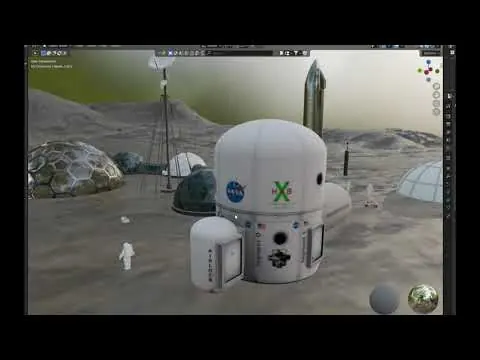 ▶ Watch the original demo on YouTube ↗
Project facts
- Track / challenge
- Your Home in Space: The Habitat Layout Creator
- Team
- 6 people · BR
- Build
- software only
- AI
- None stated
Problem
A habitat has to keep a crew alive — mass, power, life support, shielding — and survive space weather; a layout tool alone cannot tell you whether the crew would survive in it.
Solution
An interactive systems-engineering platform to design and model habitats in 3D that recalculates crew requirements (mass, power, life support) in real time from crew size and mission duration, checks shielding materials against destination hazards, and pulls live events from NASA's DONKI space-weather database to hit the design with current solar storms.
Demo moment
Team-described: when a solar flare is recorded in NASA's DONKI feed, an alert appears and the habitat in the simulation takes the storm — is the shielding enough, is the storm shelter in the right place?
Why it stood out
- organizer statedWon the award for the most plausible concept and design.Source ↗
- organizer statedConsiders the critical functions of living in space — waste management, power, life support, communications — and tests designs against real space-weather threats.Source ↗
- team statedGoes past the brief's layout tool: live crew-requirement calculations turn it into a survival simulator ('not if a habitat can be built, but if its crew can survive in it').Source ↗
- team statedA live link to NASA's DONKI database tests designs against the Sun as it is today rather than a historical model.Source ↗
- curator inferenceAdding a failure test with live data turns a drawing exercise into validation — which is what 'most plausible' rewards.
Lessons for your next hackathon
- Give any design tool a stress test with live, real data; judges reward designs that can fail.
- Reframe the deliverable one level up (layout tool → survival simulator) and say it in one line.
- LATAM precedent: a team from Brazil won Best Mission Concept.
Similar situations
Projects that share domains, mechanisms or judging lenses — often with a different problem and stack.Tune the comparison.
 ▶ Video
Award winner · 2024
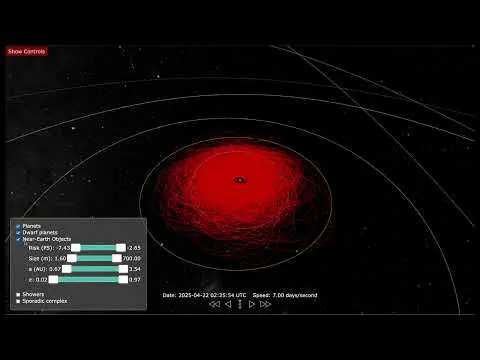
A physically based 3D orrery that puts near-Earth objects and meteoroid streams in one view to show the overlooked hazard to satellites.
Shared: domains space operations · mechanisms visible engineering depth · lenses scientific validity, design ux
 ▶ Video
Award winner · 2025
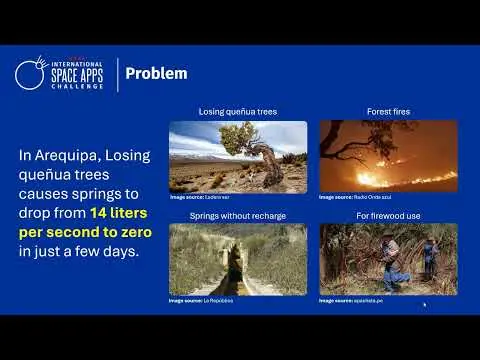
Smart reforestation of Arequipa's queñua forests against water scarcity, combining NASA vegetation indices, drone mapping, AI and native microorganisms.
Shared: mechanisms human stakes, visible engineering depth · lenses challenge relevance, scientific validity
Award winner · 2025
Orbital debris compliance and risk intelligence: automated Debris Assessment Software runs, ready-to-file disposal reports and a risk index for every object.
Shared: domains space operations · mechanisms visible engineering depth · lenses challenge relevance
Award winner · 2025
Optimization model that decides when and where orbital data centers beat terrestrial ones for AI and Earth-observation compute.
Shared: domains space operations · mechanisms visible engineering depth
 ▶ Video
Award winner · 2024
A U-Net deep network on decomposed seismic energy that finds the onset of moonquakes and marsquakes in noisy lander data.
Shared: mechanisms visible engineering depth · lenses scientific validity, challenge relevance · stack github pages
Award winner · 2025
Satellite broadband for India designed as sovereign national infrastructure: low-cost phased-array terminals linked to a laser-meshed LEO constellation.
Shared: domains space operations · mechanisms human stakes
Sources
- https://www.nasa.gov/learning-resources/stem-engagement-at-nasa/nasa-announces-2025-international-space-apps-challenge-global-winners/ · official results · retrieved 2026-09-14
- https://www.spaceappschallenge.org/2025/awards/ · official event page · retrieved 2026-09-14 — Award definition.
- https://www.spaceappschallenge.org/2025/find-a-team/pureflow2/?tab=project · project page · retrieved 2026-09-14 — Team-written summary, features, DONKI integration, AI-use note (audio).